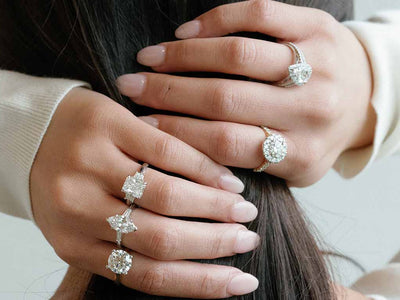

When you’re ready to get down on one knee and pop the question, make sure you have the perfect engagement ring in hand. It doesn’t matter whether they lean towards traditional and timeless designs or yearn for something colorful and contemporary: there’s guaranteed to be an engagement ring style out there for your special someone.
If you’ve already started the process of wedding jewelry shopping, you might’ve felt overwhelmed by the endless engagement ring types on the market. Make your experience seamless and simple by researching different ring settings ahead of time.
- What is an Engagement Ring Setting?
- Why Are Engagement Ring Settings Important?
- Understanding the Anatomy of an Engagement Ring
- An Alphabetical List of Engagement Ring Setting Styles
- How Are Vintage Engagement Ring Styles Different From Modern Designs?
- How Do You Choose the Right Engagement Ring Setting?
- Engagement Ring Settings FAQs
[product_card border="#BDB39B" image="https://www.finks.com/cdn/shop/files/NS409914_3_76410dd2-76cb-40ba-b449-62fa84031a2b_1024x1024@2x.png?v=1771351590" alt_text="The Studio Collection Round Diamond Engagement Ring with Diamond Shank in Platinum and Yellow Gold" eyebrow="The Studio Collection" product_name="Round Diamond Engagement Ring with Diamond Shank" cta_url="/products/the-studio-collection-round-diamond-engagement-ring-with-diamond-shank-in-platinum-and-yellow-gold" target="_blank" cta_text="Shop Now"]
What is an Engagement Ring Setting?
In the simplest of terms, engagement ring settings are the metal framework made to secure a center diamond or other gemstone to the band. The type of setting chosen determines more than how safely a stone is mounted to a ring—it transforms the overall finish and feel of the jewelry as a whole. In fact, even if you weren’t aware this aesthetic detail was called a “setting,” you likely already have your favorites, whether it’s the solitaire engagement ring you grew up seeing on your mother’s hand or the collet-set old mine cut diamond on Taylor Swift’s ring finger.
Why Are Engagement Ring Settings Important?

While there are many design decisions to make throughout the process, from the size and shape of the center stone to the type of metal used and beyond, picking the right engagement ring setting for your partner is one of the most important. The setting is responsible for making sure the center stone does not easily fall out during everyday wear.
Though the level of durability and security can vary depending on the engagement ring style, the protective metal framework is just as much of a practical and functional element as it is aesthetic. If you live a more active lifestyle, for instance, you might consider buying a more secure engagement ring style; if you don’t regularly work with your hands, you may get away with a more dramatic, high-profile setting.
Engagement ring settings also directly impact the visible size of the center stone and sparkle that emanates from the gemstones. The prongs and bezels that wrap around a stone affect exactly how much light enters, bounces around, and passes through the center stone. Certain settings have the power to change how small or large a diamond looks, making your priceless purchase look even more impressive.
Understanding the Anatomy of an Engagement Ring
In order to fully comprehend the different types of settings, it helps to learn the vocabulary for the different parts of an engagement ring. Once you understand the basic anatomy of a ring, it’ll be easier to describe to your jeweler what kind of designs you’re looking for.

Basic Ring Vocab to Know:
- Head: the top portion of the ring that holds the main stone in place and is responsible for determining how high the stone rests above the finger
- Band (or shank): the circle of metal that wraps around the wearer’s finger and holds up the setting
- Gallery: the open space below the stone that supports the overall setting shape and allows light to shine through the stone from below
- Prongs: the small metal arms (typically four or six) that hold the stone within the head of the ring and affect how much remains visible to the human eye
- Shoulders: the sides of the band that extend towards the center stone, connecting the shank to the head and influencing how the ring appears when viewed from above
- Bridge: the support section underneath the head that helps evenly distribute the weight of the center stone across the band
- Sizing bar: the small section opposite the center stone on the bottom of the shank, allowing the ring to be resized for future fittings
An Alphabetical List of Engagement Ring Setting Styles
Whether you’re in the initial stages of browsing online or heading to your fifth jewelry store to narrow down your options, looking at all the different engagement ring styles and envisioning how one might fit in your future together is exciting. Each setting offers its own level of security, shine, and style.
While it’s an important choice to make, there’s no reason it should feel daunting. Take a look at the different engagement ring types below to familiarize yourself with the options so you can pick the perfect one.

Bar Engagement Rings
Bar engagement rings are a more modern style in which multiple gemstones are secured into place with vertical metal bars instead of traditional prongs. The diamonds are placed side by side and secured in place with bars to highlight the framework as much as the gemstones. With each stone individually supported, the setting distributes the pressure evenly across the band, making it a great choice for those who wear their rings frequently and may be scared of knocking out a stone in their day-to-day life.
Basket Engagement Rings
Basket engagement rings use multiple prongs that branch out from beneath the center stone to hold it in place. The name is a clear reference to the fact that the metal framework appears almost woven together, like a basket.
Each metal strand is both delicate and strong, allowing enough light to enter the stone for maximum brilliance as well as protecting it from easily falling out of place. Depending on the designer, a basket engagement ring can be low or high profile.
Are Basket and Prong Engagement Rings the Same?
While similar, basket and prong engagement rings are not the same. Classic prong settings feature vertical metal claws that extend directly from the band, whereas basket settings cradle the stone from underneath and connect the prongs for added durability and a more vintage, cottagecore style.
[product_card border="#BDB39B" image="https://www.finks.com/cdn/shop/files/NS411442_de54310f-12b0-4f78-83ad-4f659e4bfc8e_1024x1024@2x.png?v=1756311747" alt_text="The Studio Collection Bezel Set Emerald Cut Diamond Engagement Ring" eyebrow="The Studio Collection" product_name="Bezel Set Emerald Cut Diamond Engagement Ring" cta_url="/products/the-studio-collection-bezel-set-emerald-cut-diamond-engagement-ring" target="_blank" cta_text="Shop Now"]
Bezel Engagement Rings
Bezel engagement rings use metal to encase and secure the edges of the center stone in place. Sometimes called a “rubover,” the bezel setting ensures that only the crown of the gem is exposed and provides a smoother border around the stone than traditional prong settings. It’s a historic technique, seen frequently in ancient jewelry, but with its snag-free design and enhanced protection, a sleek bezel ring will never go out of style.
Types of Bezel Settings:
- Full bezel: one band of metal encircles the center diamond’s full perimeter
- Partial bezel: also called a half bezel, the band of metal wraps two opposing sides of the stone and leaves certain sides open for more light to enter and sparkle
- Split bezel: the band of metal covers the top and bottom anchor points and keeps the sides more open for a unique aesthetic
- Collet: a vintage-style bezel setting that’s like a hybrid between bezel and prong settings, with the metal just covering the edges of the diamond while prongs gently wrap the top
Cathedral Engagement Rings
Cathedral engagement rings draw inspiration from traditional church architecture, using arches of metal that extend from the band to flank and support the center stone. As one of the higher-profile settings, cathedral designs offer a luxurious and regal feel to the finger and noticeably increase the amount of light exposure for maximum brilliance.
Channel Engagement Rings

Channel engagement rings take a prong-less approach, securing a row of gemstones between two parallel metal stripes. Since the diamonds are set within protective metal walls, they are less exposed to daily wear and tear, making them all but immune to damage. The number of diamonds depends on the style, with certain designs featuring a complete circle of stones and others opting for specific portions, but one thing remains the same: the channel engagement ring offers exceptional craftsmanship and style.
Pro tip: Channel settings are often seen more in wedding bands than engagement rings. If you want to increase the sparkle on your ring finger, consider looking for a cathedral or halo setting for the engagement piece and purchase a channel-set ring for your wedding band.
Cluster Engagement Rings
Cluster rings feature multiple smaller gemstones, arranged close together, rather than one large center stone. Intricately setting numerous stones together produces an unmatched radiance from every angle and allows the wearer to shine with every wave of their hand. Jewelers can choose to mix and match different gemstone shapes, colors, types, and cuts for endless cluster engagement ring styles perfect for those with more maximalist tastes.
East-West Engagement Rings
East-west engagement rings set a center stone horizontally across the band, rather than the traditional north-south orientation, hence the name. An alternative to more classic vertical settings, east-west engagement rings create an illusion that the center stone is more substantial, as it covers more of the finger width. The effect only works if the stone is a more elongated shape, like an oval or an emerald cut.

Best Diamond Shapes for East-West Engagement Rings:
Flush Engagement Rings
Flush engagement rings, sometimes referred to as gypsy or burnish engagement rings, set the gemstones in drilled holes within the metal band so that the stone is entirely flush with the surface. Contrary to more common prong or bezel settings, flush engagement rings have no protruding edges, keeping the dazzling diamonds secure and offering a completely smooth appearance. The shape of the gemstones can vary and be mixed and matched for endless combinations.
Halo Engagement Rings
Halo engagement rings feature a larger main stone encircled by a ring of smaller gemstones. The halo reflects extra light into the center stone and makes it appear even larger, making it a great option for those who want added brilliance but cannot necessarily afford a stone with a larger carat weight. Originally popular in the 1920s Art Deco era, halo engagement rings have become a staple in wedding jewelry.
Hidden Halo Engagement Rings

Hidden halo engagement rings are a slightly different alternative to the normal halo setting. From above, the design appears to be a classic solitaire ring—but when examined from the side, you’ll spot a concealed ring of smaller accent diamonds. With these added gemstones tucked beneath the main stone, hidden halo engagement rings offer a subtle way to enhance a timeless design and let the main diamond continue to be the focal point.
Pavé Engagement Rings
Pavé engagement rings incorporate tiny accent gemstones along the metal band to create a continuous glittering style. In the intricate pavé engagement ring type, each small diamond is held in a tiny, drilled hole by microscopic beads or prongs. Pavé-set stones can be added to other settings and add an overall brilliance without drawing any attention from the main stone.
Prong Engagement Rings
Prong engagement rings have multiple metal tips that extend from the base of the ring to wrap around the girdle of a center stone. The cradle can be made up of 4 prongs that showcase more of the diamond, or 6 prongs for more security, depending on the design. Prong settings can be used with almost any diamond shape, making them one of the most versatile options on the market.
Solitaire Engagement Rings
As the name implies, solitaire engagement rings are made up of a single center diamond set on top of a simple, often unadorned, band. Most designs use prongs to lift the stone and keep it secure, but plenty of jewelry designers experiment with alternative options to create one-of-a-kind pieces. First made popular by Tiffany & Co., solitaire engagement rings remain one of the most iconic styles worldwide.

Split Shank Engagement Rings
Split shank engagement rings have a band that breaks off into two or three arms before reaching the center stone. These smaller bands can be decorated with pavé stones or left plain, but either way, the open metal framework helps the main diamond appear larger to the average onlooker. The intertwined and weaving split shank engagement rings are often said to represent your and your future spouse’s paths converging together, making it a meaningful choice.
Tension Engagement Rings
Tension engagement rings are a more recent advancement in jewelry design where, unlike traditional prong or bezel settings, there is no visible support over or under the stone. Instead, the center diamond is made to look like it’s floating in mid-air, with a calibrated metal band pushing against either side of the girdle into tiny grooves to grip it into place. Delicate, precise, and oh-so-captivating, a tension engagement ring is sure to amaze everyone around.
Three-Stone Engagement Rings
Three-stone engagement rings are made up of one large center stone and two smaller side stones. On a three-stone engagement ring, the gems are meant to represent the past, present, and future of your journey together.
While all three stones are often diamonds, many people opt for other, more colorful side stones. What could make an engagement ring more special than adding a few meaningful birthstones?
[product_card border="#BDB39B" image="https://www.finks.com/cdn/shop/files/NS312174_1caff0d0-7a01-4aad-892c-94555f45f943_1024x1024@2x.png?v=1771336915" alt_text="The Studio Collection Emerald Cut Diamond Engagement Ring with Baguette Accents in Platinum" eyebrow="The Studio Collection" product_name="Emerald Cut Diamond Engagement Ring with Baguette Accents" cta_url="/products/the-studio-collection-emerald-cut-engagement-ring-with-baguette-accents-in-platinum" target="_blank" cta_text="Shop Now"]
Popular Gemstone Alternatives for Three-Stone Engagement Rings:
- Sapphires
- Emeralds
- Rubies
Toi Et Moi Engagement Rings
Toi et moi engagement rings feature two main gemstones sitting side-by-side on the same band, equally gorgeous and on display. Traditionally, this engagement ring type, French for “you and me,” showcases two different shapes to represent the unique qualities of each partner. Some famous females, namely Jackie Kennedy and Megan Fox, have sported toi et moi rings.
How Are Vintage Engagement Ring Styles Different From Modern Designs?

Vintage engagement ring settings tend to use more simplified, low-profile metal mountings to hold the center stone in place, rather than elaborate prongs and suspended shanks. Since most diamonds were cut by hand before the 1950s, with broader facets, visible cutlets, high crowns, and small tables, the brilliance leaned warmer, as opposed to modern gemstones. Certain techniques, like filigree and milgrain, were frequently used to embellish the band, something rarely seen in high-end jewelry brands today.
If your soon-to-be fiancée prefers a more antique look, you could purchase an heirloom piece, search for specially designed modern pieces, or work with a jeweler to bring your vision to life. Before you shop for a more vintage engagement ring style, make sure you understand exactly which era you’re looking for.
Popular Eras of Vintage Engagement Rings:
- Georgian (1714-1837): hand-foiled gemstones, closed-back settings, yellow or rose gold metals, and more natural motifs, such as flowers and ribbons
- Victorian (1837-1901): cluster engagement settings, colorful gemstones, and romantic heart-shaped details
- Edwardian (1901-1915): elaborate filigree and milgrain details, lace-like settings, and Old European cut diamonds
- Art Deco (1920-1935): bold geometric shapes, perfect symmetry, step-cut diamonds, and colorful accent gemstones
- Retro (1935-1950): oversized settings, statement-sized diamonds, high-profiles, and fancy stone cuts
How Do You Choose the Right Engagement Ring Setting?
Once you feel like you have your footing with the different engagement ring types, it’s time to actually start your search. But how? With a professional by your side, finding the perfect engagement ring style is a piece of cake—especially if you follow our tried-and-true tips.

3 Tips for Selecting an Engagement Ring:
- Tip #1: Set a budget
- Tip #2: Choose a diamond shape
- Tip #3: Build a relationship with your jeweler
Tip #1: Set a Budget Before You Shop
You might’ve heard that an engagement ring should cost two or three months of your salary, and while that’s not necessarily a hard and fast rule, it’s not a bad idea to set a budget before you shop. It doesn’t matter whether you can afford $1,000 or $10,000—as long as you know exactly what you’re comfortable spending, you’ll be able to find the right engagement ring for you – without breaking the bank.
Once you know what you’re willing to spend, you and your jeweler can work hand in hand to shop designs that fall within your desired budget. With countless designs to choose from, you’re bound to find something worthy of your precious partner.
Tip #2: Choose a Flattering Diamond Shape

When it comes to engagement ring styles, setting isn’t everything. Diamond shape is one of the most important aesthetic choices you’ll have to make. In fact, it’s something most brides have dreamed of since they were little girls! If you don’t already know what diamond shape she wants, talk to your jeweler about the most flattering pairing for the setting you’re interested in.
Popular Settings for Common Diamond Shapes:
- Round: classic prong, halo, bezel, cathedral, or pavé
- Oval: solitaire, halo, bezel, or east-west
- Pear: solitaire, bezel, halo, or three-stone
- Princess: channel, three-stone, or V-prong solitaire
- Emerald: bezel, halo, or east-west
- Cushion: hidden halo, pavé, or solitaire
Tip #3: Build and Maintain a Relationship with Your Jeweler
Just because you’ve taken home the engagement ring and successfully proposed doesn’t mean your time with your jeweler has come to an end. If you bought from a reputable store, you’ll likely want to return for your wedding bands and any future anniversary designs. The more personal your connection is with your jeweler, the more helpful they can be during servicing and shopping experiences.
Engagement Ring Settings FAQs:
What is the Most Secure Engagement Ring Setting?
As far as engagement ring types go, the bezel setting is often considered to be the most protective option out there. Instead of having prongs or metal claws that could potentially bend out of place if snagged on something, the complete metal rim of a bezel engagement ring tightly wraps around the center stone, securing it in place and preventing chips.
If the bezel engagement ring is not your style, you can always look into 6-prong engagement rings. With multiple points of contact, the prongs protect the girdle of the center diamond. Even if one snaps or buckles, the remaining prongs should be able to keep the gemstone intact until your jewelry repair appointment.

Which Engagement Ring Setting Makes the Stone Look the Biggest?
With a circle of smaller gemstones encasing the main diamond, halo engagement rings are proven to make the center stone of the design look the biggest. This timeless engagement ring style creates a masterful illusion, often making the main gem look half a carat larger.
In general, the higher the setting, the larger your diamond will appear. Other popular options for maximizing the visual illusion of size include the three-stone setting and bezel setting.
Pro tip: If you’re customizing a ring with your jeweler, they’ll likely suggest other ways to make your creation appear larger. Choosing a slim band to create a striking contrast or selecting a more elongated shape, like a pear or marquise, for the center diamond are some of the best tricks of the trade.
What is the Trendiest Engagement Ring Style?

While timelessness is always the goal with a ring they’ll wear forever, it’s impossible to escape the trends when shopping engagement ring styles. In the upcoming years, experts have noted that the chicest brides have both continued to appreciate classic solitaire rings while also leaning towards designs that scream individuality. Antique-cut stones, whether that be Old Mine or the Asscher, and bands with charming details, such as the pavé and cluster settings, are increasingly sought after.
What Engagement Ring Setting is Best for an Active Lifestyle?
If you’re someone who is always on the go, some of the most gorgeous engagement ring types out there might just not be practical for your day-to-day—but that’s okay. Low-profile engagement rings that sit close to the finger tend to be better suited for those with an active lifestyle. When browsing different options, make sure to keep bezel, channel, flush, and basket engagement rings in mind, avoiding any design with fancy diamond cuts or delicate pavé detailing.
Do Certain Engagement Ring Settings Need to Be Cleaned Differently?
Cleaning your engagement ring is the best way to ensure it remains in pristine condition for a lifetime and more. Before you attempt to clean it on your own, we recommend looking up the best way to do so for the specific setting it has, as the steps can vary depending on the engagement ring type.
More intricate settings, such as halo, vintage, or pavé engagement rings, can trap debris and oils underneath the stones and in the detailed edges. These require a gentler brush and may benefit from more frequent soaking, whereas simple settings, like the solitaire or bezel, can be wiped down for everyday cleanings and thoroughly scrubbed closer to once a month. When you purchase the engagement ring, make sure to ask your jeweler for any professional advice for home cleanings—they’ll be happy to bring you up to speed.

A General Guide to Cleaning an Engagement Ring at Home:
- Step 1: Fill a small bowl with warm water and a few drops of a mild dish soap, mixing thoroughly to combine.
- Step 2: Soak the ring for 20 to 40 minutes—the more intricate the setting, the longer the soak.
- Step 3: After the time is up, take a soft toothbrush or specialized jewelry cleaning brush and gently, yet thoroughly, scrub all of the surfaces to remove any build-up and dirt.
- Step 4: Plug or block the drain of the sink to prevent any slippery mishaps and rinse the ring under warm water.
- Step 5: Pat down the engagement ring with a soft microfiber cloth and let it fully air-dry before putting it back on your hand.
How Often Should You Have Your Engagement Ring Setting Serviced?
In order to ensure your precious halo engagement ring can last you a lifetime of love and wear, experts recommend having it professionally inspected and serviced at least twice a year. (Depending on your jeweler, this will also help you stay within warranty for your engagement ring, should there be any mishaps.) During the appointment, the jeweler will check for signs of loosening stones and worn-out prongs, as well as polish the surfaces to maintain the engagement ring style’s finish.
Pro tip: If you notice that the prongs are catching on clothing more frequently or you hear a faint rattling sound when you move the ring, you might need to bring it in for service sooner. But no worries—any jewelry store worth its salt will be happy to help.
[product_card border="#BDB39B" image="https://www.finks.com/cdn/shop/files/NS841916_1_fef7eff0-c853-43d4-a905-bc1f30ba16a1_1024x1024@2x.png?v=1771335640" alt_text="The Studio Collection Oval Diamond Engagement Ring with Round Diamond Halo in Yellow Gold" eyebrow="The Studio Collection" product_name="Oval Diamond Engagement Ring with Round Diamond Halo" cta_url="/products/the-studio-collection-oval-diamond-engagement-ring-with-round-diamond-halo-in-yellow-gold" target="_blank" cta_text="Shop Now"]
Does the Engagement Ring Setting Affect the Type of Wedding Ring You Buy?
Yes! But just because the engagement ring style makes a difference in the kind of wedding band you buy, doesn’t mean you should limit yourself during browsing. There will always be plenty of options that complement your gorgeous jewelry.
Settings that sit on top of the shank and do not intersect with the rest of the band can be paired with almost any ring, whether it’s a simple band that sits flush against the piece or a contour band that frames the center stone. While it may not offer the seamless look pre-paired rings have, it keeps the door open for your partner to choose whatever band she fancies.
If the engagement ring type features a setting that drops down and connects to the shank, then you’ll want to consider whether you like the look of a gap between the wedding band and ring or find a curved band to wear around it.
Should You Buy an Engagement Ring and Wedding Band at the Same Time?

If the proposal is not a complete surprise to you (as is happening more and more frequently with modern-day brides), you might consider buying both rings, called the bridal set, at the same time to make sure the rings you wear for the rest of your life complement one another. But let’s get one thing clear: it’s not necessary. Many people buy the designs separately to space out the costs and enjoy the two shopping excursions as separate milestones.
Can You Change the Setting on an Engagement Ring?
If the engagement ring style your partner chooses ends up not feeling quite like you or you’re looking for a way to breathe new life into an inherited ring, hope is not lost. While it’s unlikely a jeweler will take on a project that requires reworking the metal framework of a design, taking out the center diamond or gemstone and placing it into an entirely new setting is an option.
Taking the time to research the different engagement ring styles and figuring out which ones are her favorites will set you up for success when it’s time to pop the question. When you know the lingo, you’ll feel confident as you step into the jewelry store to start your search for her dream engagement ring. Before you know it, you’ll be all set.